Posts

Showing posts matching the search for Julie Seltzer

“That’s Julie Seltzer! I Invented Her Too!”

Image
Thoughts from scribe-in-residence Julie Seltzer on what she's writing, her process, and the experience of writing a Torah on public view. As I walked from the exhibit hall to the museum lobby, I stopped in my tracks when I saw the man walking up the stairs in the opposite direction. Rav Landes?! Rabbi Daniel Landes is the director of the Pardes Institute for Jewish Studies , the yeshiva 1 I attended in Jerusalem ten years ago. I have seen him a few times since then, on visits to Israel, but he was one of the last people I thought I’d run into in San Francisco, and at the museum no less! It turns out that he was just as surprised to see me. Over coffee, he reported on his experience taking a museum tour. The docent pointed out the Hebrew word פרדס ( Pardes ), which is written out in very large structural letters on the entrance wall of the museum. Pardes means orchard, and represents four different levels of understanding the Torah, from the surface level to the most hidden level.

Not So Frequently Asked Questions

Image
Thoughts from scribe-in-residence Julie Seltzer on what she's writing, her process, and the experience of writing a Torah on public view. In the gallery, visitors can leave me questions. Many of the questions are about how to deal with mistakes, or about the letters, or offers to help with proofreading (thank you!). Some of the questions are more unusual, and I thought I’d answer a few here.

Travels in Torah, and Other Scribal Adventures

Image
Thoughts from scribe-in-residence Julie Seltzer on what she's writing, her process, and the experience of writing a Torah on public view. I hail from the east coast, and moved to the Bay Area for the amazing opportunity to write a sefer Torah 1 . Last weekend, I visited New York and Toronto for a friend’s wedding, and thought some aspects of my travel were relevant enough to share.It started before my flight, back when I was writing the end of Genesis. The Torah, chronicling the end of Joseph’s life, states: “And Joseph lived in Egypt…”At the daily Q & A sessions I lead with the public in the Museum, one of the most frequently asked questions is, “What do you think about when you’re writing?”

Opening Talk: Project 304,805

Image
This is a transcript of the talk delivered by Scribe Julie Seltzer at the opening of the exhibition, As It Is Written: Project 304,805 . Julie will be periodically be sharing her thoughts on what she is writing, her process, and the experience of writing a Torah on public view. These words were offered in memory of my mother, Chaya bat Pinchas v'Batsheva. This weekend is Simchat Torah , the Celebration of Torah, which marks the end of the yearly Torah reading cycle. It feels like a particularly auspicious time to begin writing a Torah. On Simchat Torah we read the very end of the Torah, and then immediately read the beginning, making the Torah more like a circular document than a linear one.

Thanks for the Giving

Image
Thoughts from scribe-in-residence Julie Seltzer on what she's writing, her process, and the experience of writing a Torah on public view. Thanksgiving is here again! And Thanksgiving means turkey. And turkey means feathers. And it goes without saying, of course, that feathers means quills. Last year at this time, a friend went to a local farm where they kept turkeys. This friend knew I was learning scribing, having observed my collection of stray Canadian goose feathers from the grounds where we lived. He brought me back a whole bunch of feathers. “Might you use these?” he asked.

EEEEEEEEWW, BLOOOOOOOOD!!!

Image
Thoughts from scribe-in-residence Julie Seltzer on what she's writing, her process, and the experience of writing a Torah on public view. When I first started this Torah project, the question shocked me each and every time. At one point I was keeping track of how often it was asked, as well as what percentage of the questioners were women and what percentage were men. When the count was high but about evenly-split between men and women, I stopped caring and simply lost track. The question: "Can you write the Torah when you’re menstruating?” I have a question, too. What is up with everyone’s obsession with blood?! And when did my bleeding cycle become public interest law? Maybe that’s unfair. The Torah itself is a little obsessed with blood. Recently, I was writing a section of Leviticus that deals with a woman’s state of impurity following birth and the associative blood. She is considered in a state of tum’ah (generally translated as “impurity,” though Everett Fox in his inf

Is the Torah a Snoozer?

Image
Thoughts from scribe-in-residence Julie Seltzer on what she's writing, her process, and the experience of writing a Torah on public view. “Is it ever boring, writing all day?” boring: “Dull, tiresome, tedious.” “Mind-numbing, monotonous." [also: “The act or process of making or enlarging a hole.”] When I was training with Jen Taylor Friedman , I happened to be working at her studio when a local reporter visited. He asked what her favorite and least favorite sections of Torah were. At the time, I was writing a certain extremely repetitive panel of torah. When I say repetitive, I mean, repetitive. I mean when I say repetitive, I mean, repetitive. The section is Numbers 7:12-7:83. It consists of the same paragraph repeated twelve times over, but with the names of different people inserted at the beginning and end of each paragraph. Given that this was the panel I was currently writing, I immediately knew how I’d answer the question (I can’t remember how Jen responded. Jen?). I wo

Baffling Babel

Image
Thoughts from scribe-in-residence Julie Seltzer on what she's writing, her process, and the experience of writing a Torah on public view. “You began learning scribing just two years ago. Is this, perhaps, hubris?” asked the reporter. “I’m not sure what hubris means.” “Arrogance. Over-reaching.” Ah. So I’m writing the story of the Tower of Babble: the people were of “one language, of unified speech,” and they aim to build a city that reaches the heavens. Ambitious indeed! In the Torah narrative, this qualifies as hubris, and God makes sure they fail by confounding their language, losing their collective power. And as I’m writing the story, I get a bit confounded myself. Let me explain:

Not Kosher

Image
Thoughts from scribe-in-residence Julie Seltzer on what she's writing, her process, and the experience of writing a Torah on public view.  Question: Have you encountered any obstacles in this work because you’re a woman? Answer: No. The inverse seems to be true. While it is the case that my work will not be accepted by all sectors of the Jewish community, in some cases it is specifically sought after, simply because I am a woman. Feminists of the previous generation paved the way, and I just stepped into that opening. And while this is definitely true, I am now becoming more and more aware of subtle sexism – the kind that impacts everyone, not just women who are working in traditionally male fields. And it has nothing to do with halacha (Jewish law). According to traditional halacha , the Torah that I write will not be valid for ritual use. Sometimes people harp on this at the sessions, looking down at those who won’t accept it. But the fact that this Torah will not b

Covenant of the Word

Image
Thoughts from scribe-in-residence Julie Seltzer on what she's writing, her process, and the experience of writing a Torah on public view. “Is this something men do as well, or are there only female scribes?” Wow. This question, asked at one of the Q&A sessions I lead on breaks from writing, is on one level so charming. It’s not too hard to imagine that ritual calligraphy would be situated primarily in the realm of the feminine; I could see scribing lumped in the same category as baking and weaving–“women’s art.” But on another level I found the question disturbing, not having anything to do with gender at all.

Brought to You by the Letter "Peh"

Image
Thoughts from scribe-in-residence Julie Seltzer on what she's writing, her process, and the experience of writing a Torah on public view. One of the questions I am often asked is, “Do you have a favorite letter?” The 22 letters of the Hebrew alphabet (or 27, if you count the five letters that take a different form when they appear at the end of a word) feel in some ways like children. How can one have a favorite? But even with children the Torah reports to us certain leanings at certain times (“Now Isaac loved Esau, because he had a taste for game; and Rebekah loved Jacob.” Genesis 25:28). Similarly, different letters bring unique joy, new connection, and insight at different times. Past “favorites” have included the Bet , the Gimmel , and the Chet . My current leanings are toward the letter Peh , and I’ll explain why. [These Hebrew letters spelled out, by the way, are all valid Scrabble words, FYI.]

"Get Out of My Airspace!" And Other Tales From the Torah Letters…

Image
Thoughts from scribe-in-residence Julie Seltzer on what she's writing, her process, and the experience of writing a Torah on public view. When I read the article in the J Weekly entitled “Leave me Alone! And Other Tales from the Torah Scribe,” I was pretty taken aback. Were my work habits so interesting to people that this reporter wanted to give them the “inside “scoop”? And where was everything I said about loving the opportunity to share Torah with people in such an unusual way? Hmmm. But, like everything else, I realized there must be some Torah here. And that’s when it hit me: "Scribe Realizes She is a Final Chaf .” Fair enough: that title probably isn’t catchy enough for the newspaper, but that’s what blogs are for. Allow me to explain. All letters in the Torah must be whole and unbroken (except for one purposely broken letter), and they cannot be touching each other. They must be entirely surrounded by parchment, separating them as individual letters. Letters combin

Halfway There

Image
Thoughts from scribe-in-residence Julie Seltzer on what she's writing, her process, and the experience of writing a Torah on public view. Well, folks – I have reached the halfway mark. Since I’m not writing the Torah entirely in order, I actually wrote the “halfway mark” some time ago. Of course, there are multiple ways of counting “half.” By the verse. By the words. The letters. By time. Effort. While a computer count would give us different halfway points, the Talmud names דרש דרש “And Moses did inquire” (Lev. 10:16) as the Torah’s middle words, and the letter “vav” in the word גחון “belly” (Lev. 11:42) as the middle letter. This middle “vav” is enlarged in the torah, depicted here in the form of matzah. Both are beautiful mythic midway points. The two middle words are the same word, meaning “interpret.” And the “vav” is a connector letter, meaning “and.” “Halfway” is a way of marking time and space. In some ways, marking “half” is mechanical, like the way * we mark time accord

Can I Ask You a Personal Question?

Image
Thoughts from scribe-in-residence Julie Seltzer on what she's writing, her process, and the experience of writing a Torah on public view. I have a personal question for you that I didn’t want to ask in front of the group during the Q&A session. Would it be alright to email you? Ah, the familiar “personal question.” This is generally a polite way of saying, “Tell me about your menstrual cycle and how it affects Torah writing.” At least she didn’t ask it in front of everyone. And at least she prefaced it by acknowledging the personal aspect of it. Not everyone does. When her email arrived a few days later, it was not what I expected:

"What do you do when you make a mistake?"

Image
Thoughts from scribe-in-residence Julie Seltzer on what she's writing, her process, and the experience of writing a Torah on public view. One of the fascinating rules of sacred writing is the principle that a letter cannot be formed by an erasure. How could a letter be formed by erasure? Funny you should ask! I ran into the very possibility just today. Here is a picture of (what is supposed to be) the Hebrew word עד, meaning “until.” As you can see, there is an ink drip to the left of the letter dalet . Of course, I want to remove this ink drip, but I can’t just scratch it off. Here’s why. The ink drip, located as it is in relation to the dalet , resembles the left leg of the letter hey. So, what we have here is not actually a dalet with an ink drop next to it, but an accidental hey . If I simply scratch off the ink drip, I form the letter dalet by carving out part of the letter hey. This would make not only the letter, but the Torah invalid. Follow the steps below to find out wha

Scribe Stares at Wall

Image
Thoughts from scribe-in-residence Julie Seltzer on what she's writing, her process, and the experience of writing a Torah on public view. Sometimes I like to stop and just stare at the wall. A really great wall to stare at is the one that leads into the Torah exhibition . Many visitors pass by without more than a glance, unable to decipher the Hebrew-laced barcode symbols that plaster the hall on either side, to the right and to the left. It’s actually my favorite part of the exhibition, this piece by Israeli artist Dov Abramson . The wall is patterned in the 613 mitzvot (commandments), with little icons symbolizing to whom and where the mitzvot apply, and what scary form of punishment will follow if they are transgressed.

Scribe/baker Julie Seltzer's Challah Recipe

Image
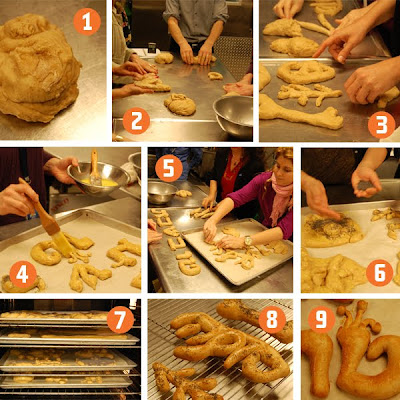
1) Portion dough 2) Knead dough 3) Sculpt dough 4) Brush with egg 5) Arrange on baking sheet 6) Sprinkle with poppy seeds 7) Place in oven and bake at 350 degrees until it is golden brown 8) Allow to cool on rack 9) Enjoy!

The Whole Megillah

Image
Thoughts from scribe-in-residence Julie Seltzer on what she's writing, her process, and the experience of writing a Torah on public view. What does a scribe dress as for Purim? Why, a megillah , of course! This past weekend was Purim, when, among other less holy activities, we read Megillat Esther – The Scroll of Esther. Megillat Esther must be read from a parchment scroll, making it a favorite holiday for scribes! Writing Megillat Esther is often the first big undertaking for a scribe. For the most part, the same rules apply as apply to Torah, though some authorities allow for more leniencies, such as permitting decorations in the margins, and special flourishes with the crowns (called taggin ). Additionally, Megillat Esther contains no names of God – so the newbie scribe does not have to worry about all of the rules and weightiness associated with writing a Name. We talked about this and more, as we shaped Hamantashen – the traditional Purim cookie – at last week’s baking cla

A Year Later

Image
Thoughts from scribe-in-residence Julie Seltzer on what she's writing, her process, and the experience of writing a Torah on public view. Last year, b’etzem hayom hazeh , on this self-same day, As It Is Written: Project 304,805 opened. Another important event in my life happened on this day as well: sixty-one years ago, on October 8th, 1949, my mother, z”l, was born.

Public Prayer

Image
Thoughts from scribe-in-residence Julie Seltzer on what she's writing, her process, and the experience of writing a Torah on public view. Imagine you’re in a room, praying. You’re not the only one there – in fact, at times there are many others in the room too. They’re not praying. They’re watching you pray. As you pray (or do your very best), you have an awareness of their presence. You wonder: What are they looking at? Do they want to learn something specific? Are they looking with a critical eye? Do they want you to stop what you’re doing and pay attention to them? Then they begin talking about you: Look at how she sways back and forth. Can you see which prayer book she’s using? Look at her outfit – I wonder if she always wears such bright colors. They speak in soft voices, thinking you’re so engrossed in your activity that you can’t hear them talking about you. But the heightened level of awareness that you’ve reached bleeds into an awareness of them, too.